When the last notes faded at A-Town Bar & Grille in Arlington, doubts were heavy. The neighborhood was rapidly changing; the landlord wanted a fresh concept, and the sprawling space was notoriously difficult to navigate. When co-owners Scott Parker and Nick Cordero announced they were transforming the location into a massive, German-style beer hall, the skeptics lined up. People openly questioned if such a niche concept could survive in the old, cavernous A-Town footprint. Today, those doubts feel like a lifetime ago.
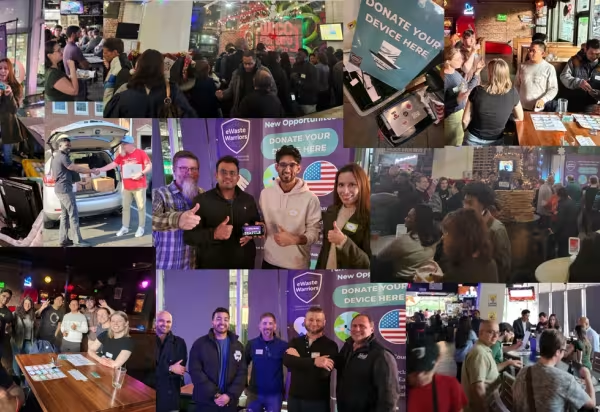
Walk into Bronson Bierhall on any given Tuesday afternoon, and you will find a vibrant cross-section of Ballston completely at home. In one corner, a corporate happy hour is winding down; in another, a couple is laughing through a first date. Near the sunlit patio, a family sits with their kids, while dogs rest by water bowls, waiting patiently for treats. Bronson has embedded itself into the daily rhythm of the neighborhood.
"We've been really lucky to be busy all the time," Scott Parker says, reflecting on the journey from a nerve-wracking launch to establishing a neighborhood staple. "Even on Mondays and Tuesdays there are people in there, whereas a lot of bars are only busy on Thursday, Friday, and Saturday."
An Arlington-First Approach
The secret to their survival and subsequent boom wasn't strict adherence to Bavarian tradition, but rather an acute understanding of Arlington itself. As Ballston surged, adding several massive residential towers right outside Bronson's doors, the neighborhood grew denser, younger, and hungrier for real community spaces.
I always say it’s not because of me. It’s because of the city,
To serve a community with high expectations, Parker and Cordero made some bold operational bets that initially rattled locals accustomed to high-touch hospitality. From day one, Bronson eliminated traditional table servers, asking guests to order via QR codes or directly at the bar—a staffing model designed to cut down on the chaos of managing massive schedules. It was a brief cultural shock for the neighborhood, but a necessary evolution.
"It was a little jarring at first for some people," Parker admits. "But when you eliminate that friction, it really makes the restaurant much easier to run."
The gamble paid off. Time and overhead that would have been spent adjusting schedules, finding staff, navigating challenging expectations were all but eliminated. Ballston adapted quickly, appreciating the freedom to set their own pace, and the model proved so efficient that Parker later carried it over to his other ventures.
Evolving the Menu
That same adaptability reshaped the menu. While the beer hall concept was originally inspired by Cordero’s trips to New York City beer gardens, the food and drink quickly evolved to match what Arlington actually wanted. Cordero, a chef with over 40 years of experience, initially anchored the kitchen with German classics like schnitzel and bratwurst. Over the years, however, the kitchen shifted toward a more eclectic, approachable American style.
"I don't know if it would be fair to say that our menu is super German at this point, but it makes our customers happy," Parker says. "They want good stuff. They might come in and eat the tacos we have on the menu, or order pizzas."
The beverage program underwent a similar, customer-driven evolution. Behind the bar, partner Gary Koh—a 30-year veteran of the trade, curates a tap list so high-volume that local breweries frequently tell the team they sell more beer at Bronson than anywhere else in their distribution networks. That massive sales volume allows Koh to be incredibly selective, bringing in the absolute best craft barrels available on the market.
Beyond the Pint
Yet, the biggest shifts in recent years have happened away from the traditional pint glass. The common misconception is that a beer hall only sells alcohol, but Parker points out they are deeply anchored in food, cocktails, and increasingly, sobriety.
"Our non-alcoholic beer sales have spiked incredibly in the past few years," Parker says, noting the clear cultural shift toward cutting back.
Meeting the community where it is, Bronson also introduced a hemp-derived THC beverage menu. Operating within strict Virginia regulations, the drinks are capped at two milligrams of THC per can, offering a casual alternative for a demographic focused on the social experience rather than the buzz.
By listening to the neighborhood instead of a textbook definition of what a beer hall "should" be, Parker and Cordero and the partners at Bronson turned a risky transition into an indispensable local hub. Bronson did not force Arlington to accept a German beer hall; its success was set by letting Arlington locals dictate what the space needed to become.
Our Story Process
This profile was developed through our independent editorial process to ensure clarity, accuracy, and a fresh local perspective. No part of this story was paid for, sponsored, or tied to any monetary exchange. Our reporting relies on first-person insights to craft a unique and original story.
Additional Stories
Taste Over Spreadsheets: How Maison Cheryl’s Chef-Owner Built a Stable Footing in Clarendon
How Ravenna Pizza Brought the Authentic Roman Square Slice Pizza to Arlington