The rush inside Immigrant Food’s Ballston location arrives with the clinking of glassware and the steady hum of neighborhood conversation. From the sidewalk, looking through the windows of the Nature Conservancy building on Fairfax Drive, the space mirrors an upscale feeling casual neighborhood joint. The bold, fun menu typography, mixed with the vibrant artwork, reveals a radical departure from standard hospitality.
The restaurant operates on a concept founders Peter Schechter and Téa Ivanovic call “gastroadvocacy” an intentional blur of food-based hospitality and civic engagement leveraged to celebrate and defend the immigrant stories that have shaped American culture for generations.
Two Beating Hearts
Immigrant Food emerged from a sense of political urgency. Schechter, who has his own immigrant story from Italy, noticed a sharp shift in the national temperature. For the first time in his memory, the fundamental idea of America as a welcoming nation felt actively under threat.
The story of America is the story of immigrants, immigrants and food are irrevocably intertwined.
With his past career split between international politics and hospitality, Schechter wanted to fuse two of his passions of food and advocacy. When presented with the opportunity, he tested the concept with friends, raised an initial funding round, and later connected with Ivanovic at a Johns Hopkins University alumni event. United by a shared vision, they opened their first location in November 2019, just half a block from the White House—a deliberate, physical message planted at the seat of American power.
Ivanovic describes the restaurant as operating with two beating hearts. One is the culinary side, defined by combining culinary ingredients and global flavors. The other is a platform for direct advocacy.
Alongside the cocktail list sits a weekly “Engagement Menu,” which outlines low-friction actions guests can take, such as signing petitions, volunteering, or downloading an educational podcast. The restaurant also publishes The Think Table, a monthly digital mini-magazine that breaks down dense policy topics—such as sanctuary cities or immigration court backlogs—into digestible, actionable deep dives. Asking when the founders find time to sleep, they say they would like to get more of it.
Suitcases, Vespas, and Survival
The concept had barely established its footing when the COVID-19 pandemic hit in March 2020. For a brand-new business built entirely around physical gatherings, the shutdown presented a genuine threat that many other businesses faced.
With no playbook to follow, the team stripped operations down to the essentials. Ivanovic assumed day-to-day financial control, and both founders moved to the front lines, spending their days washing dishes, packing takeout containers, and scrubbing bathrooms. When third-party delivery apps refused to service distant neighborhoods, Schechter and Ivanovic hopped on Vespas to deliver single sandwiches themselves. To generate revenue, they hosted virtual arepa-making classes, dropping off ingredient kits at customers’ doorsteps in the early morning hours before broadcasting the cooking tutorials later that afternoon.
The operational pressure peaked again around the January 2021 presidential inauguration. With their main location situated steps from the executive mansion, they were completely under military lockdown with checkpoints and heavy security. Commercial delivery trucks could not gain access to the zone. Rather than closing, Schechter and Ivanovic purchased their kitchen supplies themselves, packed them into oversized suitcases, and dragged them on foot through multiple layers of security checkpoints just to keep the kitchen firing.
“That period defined the company,” Ivanovic recalls. “Not because it was dramatic, but because it clarified what Immigrant Food actually was: not a concept designed for ideal conditions, but a mission resilient enough to survive impossible ones.”
Becoming Part of the Arlington Fabric
When the opportunity arose to expand to Arlington in August 2024, the founders applied their lessons to the new Ballston footprint. They built an expansive central bar, an outdoor patio, and a private dining room dedicated to community forums and nonprofit training.
The neighborhood response marked an immediate shift from the transient, commuter-heavy environment of Washington, D.C. During construction, Arlington residents routinely stuck their heads through the door to welcome the team and ask when the kitchen would open.
Arlington felt noticeably more welcoming and community-driven.
The restaurant seems to integrate with the local ecosystem, partnering with various groups like the Arlington Chamber of Commerce, neighborhood PTAs, running clubs, and nearby fitness centers.
The expansion also brought geographic market surprises. While the D.C. locations rely heavily on a dense office lunch crowd, the post-pandemic reality of hybrid work altered foot traffic patterns in Arlington. Weekday lunch traffic remained quiet, forcing the team to pivot its strategy and make the space a vibrant, evening-focused dinner and cocktail destination.
Flipping the Hospitality Playbook
Conventional restaurant industry wisdom dictates that social impact is a luxury—a marketing layer to be added only after a business achieves high profitability. Immigrant Food treats that premise as a fundamental part of modern consumer behavior.“At Immigrant Food, the mission is the business model,” Ivanovic says.
That restaurants must compete solely on transactional volume, discounts, or speed is something Immigrant Food wants to change. Instead, they wager modern diners seek emotional connection and cultural resonance.
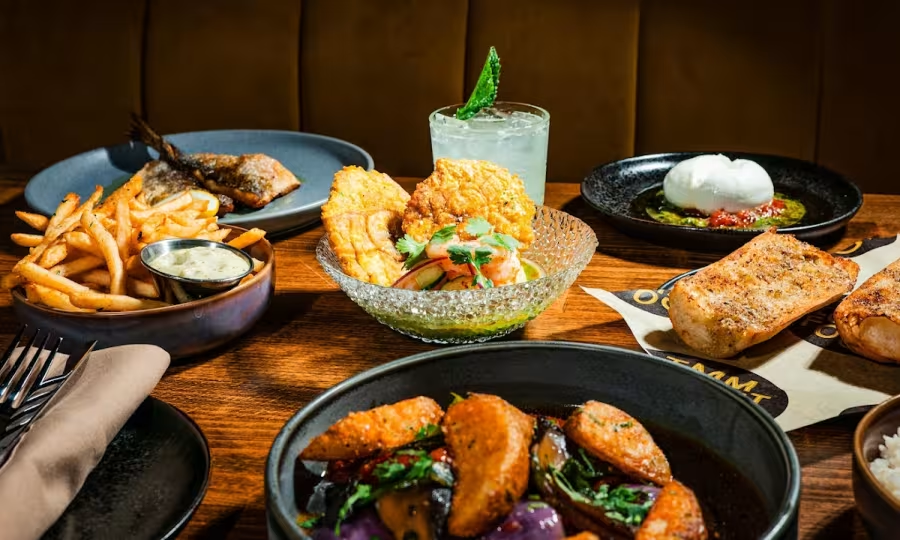
That philosophy extends directly to the culinary program, which deliberately fuses traditions rather than keeping them in isolated culinary silos. Their menu is not just a featured dish from a particular culture but many are a fusion of flavors, illustrating how naturally distinct culinary cultures complement one another.
America was born as a recipe for greatness, and immigrants have always been the ingredients.
For Ivanovic, the most satisfying impact remains internal. The company partners with local nonprofits, opening its dining rooms during off-hours for free English classes, citizenship lectures, and volunteer training sessions. Within their own ranks, they provide micro-scholarships for language lessons, charting paths for staff members to advance from back-of-house roles into fluent chefs and management positions.
For guests, there is no pressure to engage with the political or educational elements of the space; the founders maintain patrons are entirely welcome to sit and enjoy a well-crafted cocktail. But for those looking deeper, the civic purpose is baked directly into the experience.
Our Story Process
This profile was developed through our independent editorial process to ensure clarity, accuracy, and a fresh local perspective. No part of this story was paid for, sponsored, or tied to any monetary exchange. Our reporting relies on first-person insights to craft a unique and original story.
Additional Stories

German Beer and Local Tastes: How Bronson Bierhall Became Arlington’s Everyday Living Room

How Pentagon MMA Built an Arlington Community From the Mats Up